
Operational technology security has rapidly become one of the most critical disciplines in the cybersecurity industry, driven by the accelerating reliance of energy, manufacturing, transportation, and utilities sectors on interconnected industrial systems. Unlike traditional information technology, OT encompasses both hardware and software components designed to monitor and directly influence physical processes, making the consequences of a breach far more serious than a data leak alone.
The growing convergence of IT and OT networks, accelerated by Industrial Internet of Things adoption, has exposed these once-isolated systems to a threat landscape that previously only targeted enterprise networks. As attackers grow more sophisticated and regulatory pressure intensifies, industrial organizations must understand both the threats they face and the technologies available to counter them. This article covers the major trends and innovations reshaping OT security today.
Understanding the OT Landscape
Operational technology refers to the systems used in industrial control environments, including supervisory control and data acquisition (SCADA) systems, distributed control systems (DCS), and programmable logic controllers (PLCs) deployed across manufacturing, energy, transportation, and utility sectors. These systems underpin the services that modern society depends on daily, from power grids and water treatment to oil pipelines and factory floors.
OT systems were originally designed as isolated, standalone environments with no connection to corporate IT networks or the internet. That isolation made them inherently difficult to attack remotely. However, IIoT integration, cloud connectivity, and remote monitoring requirements have eliminated that separation, creating a converged environment with significant new vulnerabilities. Today, 75% of OT attacks begin as IT breaches, adding considerable complexity to the security challenge for industrial organizations. Zero Networks
The Escalating OT Threat Landscape
The threat facing OT environments is no longer theoretical. Ransomware attacks in the industrial sector spiked 87% year-over-year in 2024, making manufacturing the top ransomware target for four consecutive years. The scale and frequency of incidents continues to climb, with attackers specifically targeting industrial systems because operational disruption creates immediate pressure to pay. Zero Networks
Ransomware attacks jumped 46% in the first quarter of 2025 alone, with Honeywell’s Cyber Threat Report documenting 2,472 new ransomware victims in that period, adding to the 6,130 incidents recorded in 2024. Of the 55 cybersecurity incidents disclosed through SEC Form 8-K filings in 2024, more than half were direct attacks on OT systems. These figures reflect a calculated shift by attackers who now understand that targeting production environments creates maximum disruption. Industrial Cyber
The threat actors behind these attacks have also diversified. Several key categories of adversaries define the current landscape:
Here are the primary threat actor categories targeting OT environments today:
- Nation-State Groups: State-sponsored actors target critical infrastructure for strategic disruption, espionage, and long-term persistence, often remaining undetected for extended periods before activating payloads.
- Ransomware-as-a-Service Operators: Supply chain attacks nearly doubled from 154 incidents in 2024 to 297 in 2025, as RaaS affiliates increasingly compromise smaller vendors and managed service providers to reach larger industrial targets. Industrial Cyber
- Hacktivists: Ideologically motivated groups targeting industrial control systems for disruption, frequently exploiting exposed remote access points and unpatched internet-facing devices.
- Opportunistic Cybercriminals: Attackers leveraging automated scanning tools to identify vulnerable OT assets, particularly legacy devices with no authentication or patch support.
Best 5 Emerging Trends in OT Security
Advancements in OT security solutions are fundamentally changing how industrial organizations defend against cyberattacks. Technologies, including AI-driven detection, blockchain, and edge computing, are strengthening the defense posture of critical systems.
1. Convergence of IT and OT Security
As IT and OT systems integrate, security measures can no longer remain in separate organizational silos. Companies are implementing unified security models that bring together IT and OT visibility into a single operational framework. Many organizations are now establishing hybrid security operations centers (SOCs) that monitor both environments simultaneously, enabling teams to understand how threats in IT systems translate into risks for OT infrastructure. Rockwell Automation
The following developments characterize this convergence trend:
- Unified Asset Visibility: Platforms such as Tenable One for OT/IoT now provide consolidated risk management across IT, OT, and IoT assets within a single interface, eliminating the blind spots that separate tools create.
- Shared Threat Intelligence: Integrated environments allow threat data from IT network monitoring to be applied directly to OT anomaly detection, improving detection speed and reducing the time attackers have to move laterally.
- Cross-Domain Incident Response: Organizations are training security teams to handle both IT and OT incidents, recognizing that a breach in one domain almost always has implications for the other.
2. Increased Focus on Threat Intelligence
With the escalation of attacks targeting OT systems, the importance of real-time threat intelligence has grown significantly. Organizations are investing in sophisticated identification and surveillance technologies that provide continuous analysis of industrial network activity. These platforms apply machine learning to detect anomalous behavior in environments where traditional signature-based detection tools perform poorly.
Generative AI is reshaping both the threat and defense landscape, with threat actors leveraging GenAI tools to automate and accelerate every stage of the attack chain, including hyper-realistic social engineering, deepfake voice attacks, and context-aware phishing campaigns targeting OT personnel. Defenders are responding in kind, deploying AI-powered tools that process large volumes of industrial telemetry to detect deviations that human analysts would miss. OT Ecosystem
These capabilities are enhancing OT threat intelligence in several important ways:
- Behavioral Baseline Analysis: AI systems learn the normal operational patterns of industrial devices and flag deviations that indicate reconnaissance, lateral movement, or pre-attack staging activity.
- Threat Feed Integration: Modern OT security platforms ingest sector-specific threat intelligence feeds, providing context about known adversary tactics, techniques, and procedures targeting industrial environments.
- Predictive Risk Scoring: Machine learning models now assign risk scores to assets based on vulnerability exposure, network position, and observed behavior, helping security teams prioritize remediation actions.
3. Zero Trust Architecture
The zero trust security model has emerged as a foundational approach for OT environments, built on the principle of verifying every user and device before granting access, regardless of network location. This approach authenticates every entity attempting to access network resources, both from inside and outside the perimeter. Organizations are moving away from traditional Remote Desktop Protocols to more secure, purpose-built remote access solutions designed with zero trust principles for industrial operations. OT Ecosystem
Applying zero trust in OT requires an approach tailored to the constraints of industrial systems:
- Identity-Based Segmentation: Rather than relying on network zones alone, zero trust assigns access rights based on verified identity, role, and device health, limiting what each user or system can reach even after authentication.
- Privileged Access Management: Strict controls govern who can access critical PLCs, HMIs, and SCADA consoles, with session recording and just-in-time provisioning reducing the window for misuse or credential theft.
- Continuous Verification: Unlike perimeter-based models that trust authenticated sessions indefinitely, zero trust continuously re-evaluates access based on behavioral signals, device posture, and contextual risk indicators.
4. Enhanced Endpoint Security
As OT devices grow more connected, protecting individual endpoints has become a foundational requirement. Modern endpoint security solutions now extend to OT-specific devices, including sensors, controllers, human-machine interfaces, and programmable logic controllers. These solutions incorporate device authentication, secure boot processes, and real-time threat detection designed for environments where traditional endpoint agents cannot be installed without disrupting operations.
According to the SANS Institute 2025 survey, unauthorized external access accounted for half of all OT incidents, yet only 13% of organizations have fully implemented advanced controls such as session recording or ICS/OT-aware access management. Closing that gap requires endpoint security approaches built for the unique constraints of industrial hardware: Industrial Cyber
- Agentless Monitoring: Passive network monitoring tools observe OT device communications without requiring software installation, enabling visibility into legacy controllers that cannot support modern security agents.
- Firmware Integrity Verification: Solutions now validate the integrity of firmware running on industrial devices, detecting unauthorized modifications that could indicate a supply chain compromise or targeted attack.
- Hardware-Based Security: Purpose-built OT security appliances provide encryption, access control, and anomaly detection at the device level, protecting sensors and controllers that operate in physically exposed environments.
5. Regulatory Compliance and Standards
Regulatory bodies and industry groups are establishing increasingly stringent frameworks for OT security compliance. The NIS2 Directive, which came into effect in October 2024, significantly expands cybersecurity obligations for OT-dependent industries across Europe, introducing stronger incident reporting requirements and supply chain security mandates. In the United States, NIST 800-82 updates and sector-specific regulations from bodies such as NERC CIP continue to raise baseline security expectations. Cyber Defense Magazine
IEC 62443 has become the global technical blueprint for securing industrial automation and control systems, providing defense-in-depth guidance and risk assessment frameworks that help organizations translate high-level regulatory requirements into specific technical controls. The convergence of these frameworks is driving compliance from a checkbox exercise toward a continuous, auditable security posture. Organizations operating across multiple jurisdictions must now maintain compliance with overlapping mandates, making integrated governance programs essential. Cyber Defense Magazine
Best 6 Innovations in OT Security
New developments in OT security are reshaping how organizations protect industrial processes from sophisticated cyber threats. The following innovations represent the most significant advances driving the protection of vital infrastructure today.
1. Advanced Threat Detection and Response
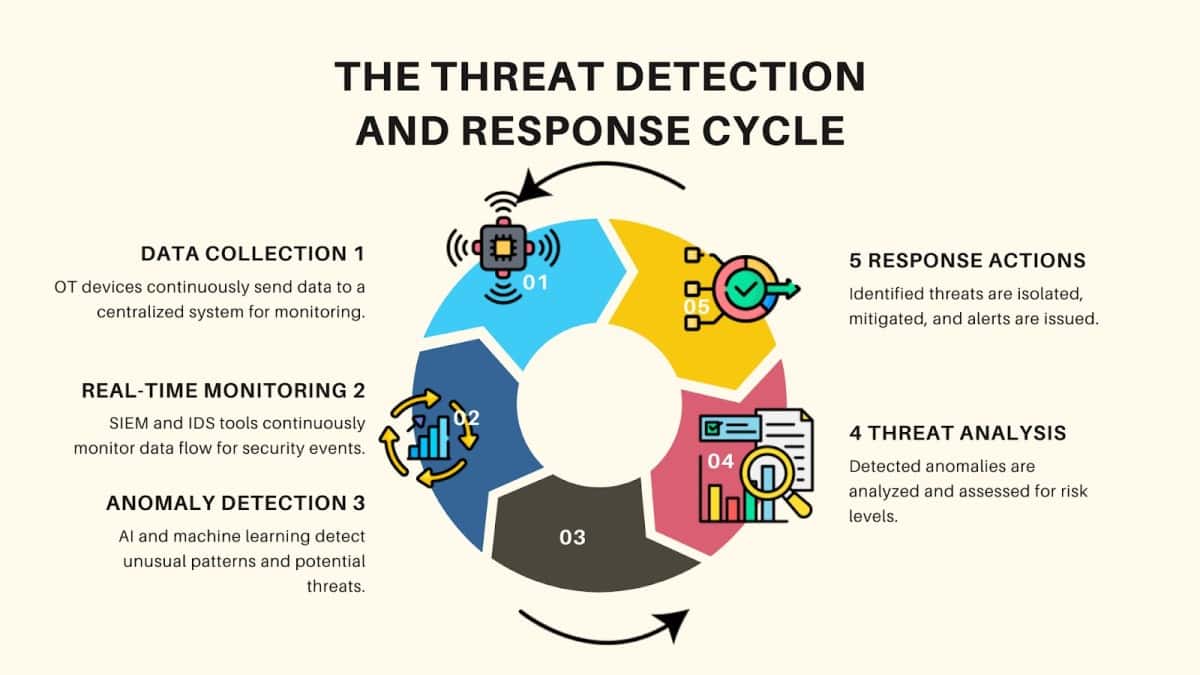
Current innovations in threat detection focus on adapting security information and event management (SIEM) systems and intrusion detection systems (IDS) specifically to OT environments, where legacy protocols and proprietary device communication make generic IT tools ineffective. These platforms provide continuous surveillance and analysis, alerting operators to suspicious activity in real time without generating the false positives that disrupt production.
AI and machine learning have significantly improved detection capabilities in industrial environments. These technologies are enabling several key advances:
- Protocol-Aware Inspection: Next-generation OT detection tools understand industrial protocols such as Modbus, DNP3, and EtherNet/IP, enabling them to identify malicious commands that appear normal to generic network monitors.
- Automated Response Playbooks: When anomalies are detected, AI-driven platforms can initiate predefined response actions, isolating affected network segments or alerting operations teams before an attack progresses to physical disruption.
- Threat Hunting Integration: Security teams now conduct proactive threat hunts within OT environments, using telemetry from SIEM platforms to search for indicators of compromise that have not yet triggered automated alerts.
2. Network Segmentation and Micro-Segmentation
Network segmentation partitions industrial networks into isolated sections, preventing breaches from spreading laterally across an environment. Micro-segmentation builds on this by creating small zones with individual security parameters and strict access policies. Dragos research found that 73% of affected assets in OT compromises were located deep within ICS environments near critical processes, underscoring the need for granular segmentation that protects the most operationally sensitive systems. Industrial Cyber
This approach limits attacker movement even after an initial intrusion. The most effective segmentation strategies today incorporate these elements:
- Purdue Model Enforcement: Organizations are reinforcing boundaries between enterprise IT networks, operational networks, and field device layers using the Purdue Enterprise Reference Architecture as a structural guide.
- Automated Policy Management: Modern segmentation platforms use AI to generate and enforce network policies based on observed traffic patterns, reducing the manual configuration burden while maintaining accurate segmentation rules.
- OT-Aware Firewalls: Next-generation firewalls designed specifically for industrial environments inspect OT protocol traffic at the application layer, enabling precise control over what commands can be issued to field devices.
3. Secure Remote Access Solutions
Remote access to OT environments is now operationally necessary, but it represents one of the most significant attack vectors in industrial security. The SANS Institute 2025 survey found that unauthorized external access accounted for half of all OT incidents, and investment in secure remote access leads planned security spending for the coming years. Organizations are replacing legacy VPNs with solutions designed specifically for industrial environments, incorporating multi-factor authentication, session recording, and role-based access controls that limit what remote users can see and do. Industrial Cyber
Current best-practice deployments for secure OT remote access incorporate several capabilities:
- SASE Integration: Secure Access Service Edge frameworks combine network and security functions in a cloud-delivered model, enabling consistent policy enforcement for remote technicians regardless of where they connect from.
- Privileged Session Management: All remote sessions to OT assets are recorded, time-limited, and governed by just-in-time access policies that expire credentials automatically after each session.
- Vendor Access Controls: Third-party and supplier remote access is managed through dedicated portals with granular permissions, preventing vendors from accessing systems beyond their authorized scope.
4. Blockchain Technology
Blockchain continues to gain traction as a tool for improving OT security through its decentralized and tamper-resistant data structures. Its ability to create an immutable audit trail makes it particularly well-suited to environments where data integrity and provenance are critical for both operational and regulatory purposes. Use cases in OT include firmware update management, identity and access auditing, and the protection of transaction records in energy trading and supply chain operations.
These practical blockchain applications are gaining adoption in industrial environments:
- Firmware Update Integrity: Blockchain-based verification ensures that firmware updates delivered to field devices are authentic and unmodified, preventing supply chain attacks that introduce malicious code through the update process.
- Identity and Access Logging: Immutable audit logs of who accessed which OT systems, when, and what changes they made provide defensible evidence for compliance audits and incident investigations.
- Supply Chain Provenance: Manufacturers and operators use blockchain to verify the origin and integrity of hardware components, reducing the risk of counterfeit or compromised equipment entering critical infrastructure.
5. Digital Twins
Digital twins are transforming OT security by creating virtual replicas of physical industrial systems that can be monitored and tested without interrupting live production. These virtual environments allow security teams to simulate attack scenarios, test configuration changes, and identify vulnerabilities in system behavior before exposing them in a live environment. Digital twins also support predictive maintenance by identifying anomalies in simulated performance that may indicate an impending failure or a developing security incident in the physical system.
The security applications of digital twins are expanding across industrial sectors. Key use cases include:
- Attack Simulation: Security teams use digital twin environments to safely test penetration techniques and measure the effectiveness of detection controls without any risk to operational continuity.
- Configuration Validation: Changes to OT system configurations, including network rules, access policies, and firmware updates, are tested in the digital twin before deployment to physical assets.
- Continuous Behavioral Monitoring: Digital twins provide a constant baseline of expected system behavior, enabling real-time comparison against the physical environment to detect deviations that may indicate an active intrusion.
6. Edge Computing and Secure Edge Devices
Edge computing processes data close to its source, reducing latency and enabling faster real-time decisions in industrial environments where milliseconds matter. Secure edge devices incorporate encryption, hardware-level access controls, and local threat detection capabilities to protect data at the network boundary. Fortinet’s latest OT security platform updates include improved OT threat visibility, hardened network segmentation, and 5G security capabilities for edge deployments in critical infrastructure. SNS Insider
Securing edge deployments in OT requires purpose-built controls at several levels:
- Hardware Security Modules: Edge devices use dedicated cryptographic processors to protect encryption keys and authentication credentials, preventing physical tampering from exposing sensitive credentials.
- Local Anomaly Detection: AI-powered security agents running directly on edge hardware analyze local traffic patterns without requiring data to be sent to a central platform, reducing latency and maintaining security even when cloud connectivity is unavailable.
- 5G Security Controls: As industrial sites adopt private 5G networks for wireless OT communications, security teams are applying network slicing, encrypted radio channels, and device authentication to prevent unauthorized access through wireless entry points.
Challenges and the Road Ahead
Despite meaningful progress, several challenges continue to slow OT security adoption across industrial organizations. Understanding these obstacles is essential for building a realistic remediation roadmap.
Legacy systems remain one of the most persistent barriers. Many OT environments still run equipment that was deployed decades ago, designed without modern security in mind and unable to support current security agents or encryption protocols. Organizations are dedicating specific budget and project time to identify and retire the most antiquated, high-risk legacy control systems that cannot be patched or securely managed, though full replacement remains impractical for most large industrial environments. OT Ecosystem
The skills shortage represents an equally serious obstacle. Effective OT security requires professionals who understand both industrial control systems and modern cybersecurity, a combination that remains rare in the labor market. The SANS Institute 2025 survey found that just 14% of respondents felt fully prepared for emerging OT threats, though organizations that involved frontline technicians in exercises were nearly 1.7 times more likely to report strong security readiness. Bridging this gap requires sustained investment in cross-disciplinary training programs. Industrial Cyber
These are the core challenges organizations must address to build lasting OT security resilience:
- Legacy System Integration: Older PLCs, SCADA platforms, and field devices lack the processing capacity and vendor support required for modern security controls, forcing security teams to rely on compensating controls like network isolation and passive monitoring.
- Skills and Workforce Development: The scarcity of professionals with combined IT and OT expertise creates gaps in security operations, incident response, and architecture review that cannot be closed through technology alone.
- Supply Chain Risk: High-profile incidents such as Colonial Pipeline and the Oldsmar Water Facility attack exposed how vulnerabilities in connected vendor systems and internet-facing OT assets can be weaponized against critical infrastructure, prompting new legislation in both the US and EU. Tosi
- Compliance Complexity: Organizations operating in multiple regions must navigate overlapping regulatory frameworks, including NIS2, NERC CIP, IEC 62443, and NIST 800-82, each with distinct technical and reporting requirements.
Conclusion
The integration of IT and OT networks has delivered measurable efficiency gains for industrial organizations, but it has fundamentally changed the security calculus for critical infrastructure. The threat landscape facing OT environments is growing more aggressive and technically sophisticated, with ransomware groups, nation-state actors, and opportunistic attackers all directing increasing attention toward industrial control systems. Organizations that treat OT security as a secondary concern to IT security operate with a dangerous blind spot.
Addressing these risks requires a layered strategy that combines advanced threat detection, zero trust architecture, regulatory compliance, and targeted investment in workforce development. Technologies such as digital twins, edge computing, and AI-driven analytics are giving defenders new capabilities, but technology alone is not sufficient. Sustained collaboration between security teams, operations teams, and leadership is what ultimately determines an organization’s ability to detect threats early and maintain operational continuity in the face of them.
Frequently Asked Questions About OT Security
What is the difference between IT and OT security?
IT security focuses on protecting data and information systems, prioritizing the confidentiality, integrity, and availability of digital information. OT security focuses on protecting physical processes and industrial equipment, where a successful attack not only exposes data but can also halt production, damage machinery, or endanger public safety. The two disciplines require different tools, skills, and risk frameworks, even as their underlying networks continue to converge.
Why is OT security becoming more important now?
The increasing convergence of IT and OT networks, driven by IIoT adoption, has exposed industrial systems to cyber threats that were previously confined to enterprise IT environments. With 75% of OT attacks now beginning as IT breaches, the risk profile for industrial organizations has expanded dramatically. Regulatory pressure from frameworks including NIS2 and IEC 62443 is further accelerating investment in OT-specific security programs. Zero Networks
What are the main challenges in implementing OT security?
The primary challenges include securing legacy OT systems that lack modern security capabilities, addressing the shortage of professionals with combined IT and OT expertise, managing supply chain risk from third-party vendors with network access, and maintaining compliance with multiple overlapping regulatory frameworks. Organizations also face the operational constraint that many OT security controls cannot be deployed without taking systems offline, which creates tension with production continuity requirements.
How does zero-trust architecture apply to OT environments?
Zero trust in OT environments means that no user, device, or system is granted access by default, even if it is already inside the network perimeter. Every access request is authenticated, authorized, and continuously verified based on identity, device health, and behavioral context. In practice, this involves privileged access management for remote technicians, identity-based network segmentation, and session recording for all access to critical industrial assets.
What regulations govern OT security for critical infrastructure operators?
Key frameworks include NIS2 in the EU, which expands cybersecurity obligations for OT-dependent industries and introduces strict incident reporting requirements; NERC CIP in North America, which applies to electric utilities; NIST 800-82 for industrial control system security guidance; and IEC 62443, the internationally recognized technical standard for securing industrial automation and control systems. Compliance obligations vary by sector, jurisdiction, and the classification of the infrastructure involved. Tosi
Suggested articles:
XXXXXXXXXX
Operational Technology (OT) security is rapidly emerging as a significant component of the cybersecurity industry, driven by the increasing dependence of various sectors on systems for critical operations. Unlike traditional Information Technology (IT) systems, OT includes both software and hardware components designed to detect or bring about changes by directly observing and influencing physical objects, systems, and events. This article discusses current trends and developments in OT security, focusing on emerging threats and the new and improved security technologies developed to protect against them.
Understanding the OT Landscape
Operational Technology refers to systems used in industrial control systems (ICS), such as supervisory control and data acquisition (SCADA) systems, distributed control systems (DCS), and other control systems used in manufacturing, energy, transportation, and utilities. These systems are critical to the smooth functioning of essential services and industries.
Initially, OT systems operated as standalone entities, independent of business IT networks and the Internet. However, the advancement in the Industrial Internet of Things (IIoT) and the integration of IT and OT networks have made these systems vulnerable to cyber threats that were initially in the IT realm. The above integration makes work and operations much more efficient and effective but comes with risks and vulnerabilities.
Best 5 Emerging Trends in OT Security
Advancements in OT security solutions are transforming industrial systems’ ability to defend against cyberattacks. Such technologies are blockchain and digital twins with related approaches, including edge computing, to strengthen the defense and cybersecurity of these systems.
1. Convergence of IT and OT Security
As IT and OT systems integrate, security measures can no longer remain isolated. Companies are beginning to implement holistic security models that interconnect IT and OT security to cover all the layers. Therefore, as both domains continue to expand, the necessity arises for security solutions tailored to their specific requirements while facilitating information exchange.
2. Increased Focus on Threat Intelligence
With the escalation of cyber threats targeting OT systems, the importance of threat intelligence has emerged. Organizations are now acquiring sophisticated threat identification and surveillance technologies that provide real-time analysis. These tools use machine learning and artificial intelligence (AI) to analyze the data and detect suspicious and anomalous activities, which can then be prevented before they occur.
3. Zero Trust Architecture
Another emerging concept in OT security is the zero-trust security model, which is based on the concept of trusting nothing and verifying everything. This approach involves authenticating every individual and device desiring to access network resources both internally and externally. Considering the Zero-Trust approach, one can reduce the risks of unauthorized access and data transfer within the OT environment.
4. Enhanced Endpoint Security
As OT devices grow more connected, protecting endpoints is critical. Modern endpoint security solutions apply to OT devices, including sensors, controllers, HMI (Human-Machine Interfaces), and PLCs (Programmable Logic Controllers). Such solutions are based on device authentication, secure boot, and real-time threat detection and prevention.
5. Regulatory Compliance and Standards
Regulatory bodies and industry groups are increasingly establishing standards and guidelines for OT security. Compliance with frameworks such as the NERC CIP (North American Electric Reliability Corporation Critical Infrastructure Protection) is becoming essential for organizations operating critical infrastructure. Adherence to these standards not only ensures better security practices but also helps in avoiding legal and financial repercussions.
Best 6 Innovations in OT Security
New developments in OT security are revolutionizing safeguarding infrastructure and industrial processes from cyber risks. Now, it is time to take a closer look at the most innovative innovations driving OT security and their significance for protecting vital processes.
1. Advanced Threat Detection and Response
Some of the new developments focus on threat detection and response mechanisms in OT environments. Products such as Security Information and Event Management (SIEM) systems and Intrusion Detection Systems (IDS) are being developed suited for the OT context. These tools offer constant surveillance and analysis, alerting users to possible risks and suspicious activities in real-time. Also, implementing artificial intelligence and machine learning improves the capacity to identify and address new threats.
2. Network Segmentation and Micro-Segmentation
Network segmentation refers to the process of partitioning a network into several sections that are confined to prevent a breach from spreading. Micro-segmentation builds on this by dividing segments into small zones with individual security parameters. This granular approach means that even if the attackers penetrate one part of the region, their movements are limited, hence minimizing the impact.
3. Secure Remote Access Solutions
The COVID-19 pandemic hastened the growth of secure remote access solutions since many OT environments needed to be monitored and managed remotely. Such advancements include VPNs, secure gateways, and strong authentication mechanisms. Security measures such as MFA and SASE are being implemented as standard practice to ensure that any form of working remotely does not weaken OT security.
4. Blockchain Technology
There is a discussion on how blockchain systems can improve OT security. Because of its decentralization and non-alterability, blockchain can serve as a means of ensuring data integrity and authenticity in the OT. Use cases of blockchain applied to OT include firmware update management, identity management, and safeguarding significant transactional records.
5. Digital Twins
OT security is being transformed by digital twins, virtual copies of tangible objects. The virtual environment allows organizations to simulate and monitor physical systems to identify any signs of threats. Digital twins facilitate predictive maintenance, minimize service time, and improve security while providing a constant audit of the system and its enhancements.
6. Edge Computing and Secure Edge Devices
Edge computing ensures that the required computational power is processed nearer to the data source, thus helping lower latency and better real-time decision-making. Safeguarded edge computing devices use security capabilities like encryption and access restrictions to secure data at the edge of networks. This ensures that all personal or restricted data does not leak out at the peripheries of the network.
Challenges and the Road Ahead
Despite the progress made in OT security, some key areas need to be addressed. The first issue is that many existing OT systems are legacy systems. Earlier systems may not be fortified with modern security processes and are challenging to integrate without interfering with business flow. Implementing security measures with these legacy systems presents many challenges that must be addressed.
Another problem is the scarcity of specifically trained cybersecurity specialists familiar with IT and OT environments. Overcoming this skills deficiency is necessary for the proper deployment and management of OT security solutions. To foster an increased understanding of OT environments, organizations need to focus on training and developing a capable workforce.
In the future, more advancements in technology development and cooperation between the related parties would form the trend of OT security. Collaboration between the public and private sectors, information exchange, and the creation of open standards will also be crucial for improving the security of critical infrastructure.
Conclusion
The integration of IT and OT has helped improve industrial processes but has also created new risks. As the threat landscape changes, the approaches and solutions used to protect OT systems should also adapt. Thus, by keeping abreast of emerging trends and implementing innovative approaches, organizations can safeguard their crucial assets and guarantee the availability of vital services.
The emerging approach of threat intelligence, network segmentation, secure remote access, and integration of new technologies like blockchain and digital twins will be the paths forward. Addressing the issues of dealing with legacy systems and skills deficits will be a collective undertaking among various players.
Finally, the concept that shapes OT security is to achieve a high level of protection that can effectively counter the growing threat landscape. Dedicating efforts toward improvement and innovation will help organizations protect themselves and the overall stability and security of the digital world.
FAQs
What is the difference between IT and OT security?
IT security focuses on protecting data and information systems, ensuring the confidentiality, integrity, and availability of data. OT security, on the other hand, emphasizes the protection of physical processes and equipment, ensuring the safe and reliable operation of industrial systems and critical infrastructure.
Why is OT security becoming more important now?
The increasing convergence of IT and OT networks, driven by the Industrial Internet of Things (IIoT), has exposed OT systems to cyber threats that were traditionally confined to IT environments. This integration enhances operational efficiency but also introduces new vulnerabilities that require robust security measures.
What are the main challenges in implementing OT security?
One of the main challenges is securing legacy OT systems that lack modern security features and are difficult to update without disrupting operations. Additionally, there is a shortage of skilled professionals with expertise in both IT and OT, making it challenging to manage and secure these environments effectively.

Daniel Raymond, a project manager with over 20 years of experience, is the former CEO of a successful software company called Websystems. With a strong background in managing complex projects, he applied his expertise to develop AceProject.com and Bridge24.com, innovative project management tools designed to streamline processes and improve productivity. Throughout his career, Daniel has consistently demonstrated a commitment to excellence and a passion for empowering teams to achieve their goals.